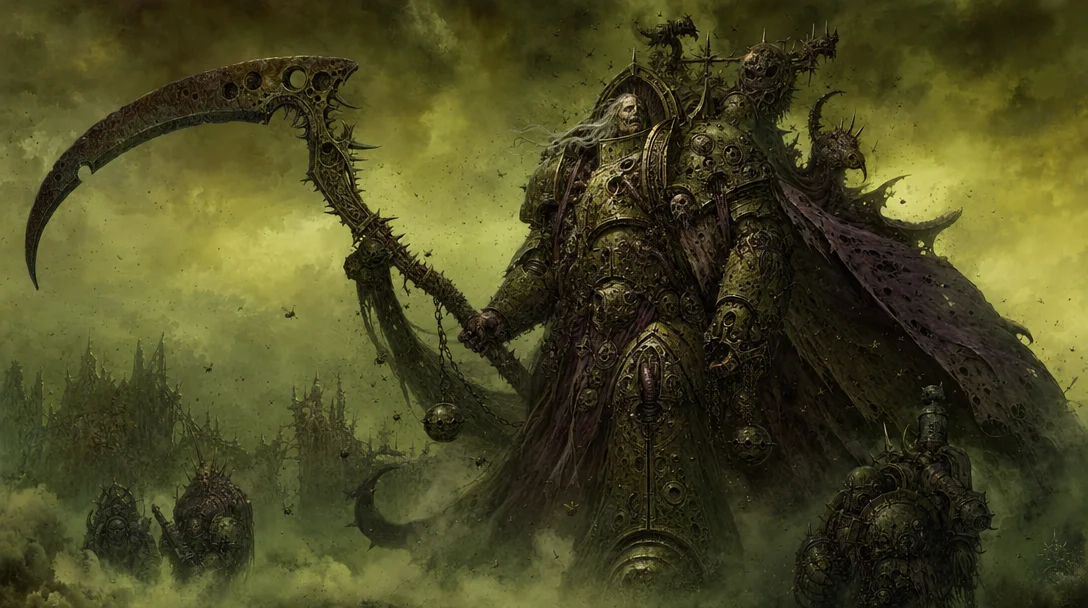
Mortarion, Part II: The Long Betrayal
From the virus-bombing of Isstvan III through the slaughter at the Drop Site Massacre, the hunt for Jaghatai Khan, and the warp trap that broke the Death Guard — Part II of Mortarion's arc follows the Horus Heresy's most methodical betrayal, ending with Mortarion's submission to Nurgle and his fateful duel with the Khan at the Siege of Terra.
This is Part II of a three-part arc on Mortarion. Part I covered his origins on Barbarus and the founding of the Death Guard. Part III will follow his post-Heresy existence as a Daemon Primarch.
The Death Guard were never meant to be what they became. They were built for endurance — Mortarion had forged them on Barbarus into warriors who could outlast anything, suffer everything, and keep fighting when every other legion would have broken. That quality was real. It just turned out to be exactly what Nurgle needed.
The story of Mortarion during the Horus Heresy is not one of a Primarch seduced by glory or power. It is the story of a man whose oldest wound — the belief that no one could be trusted, that every patron eventually betrayed you — was used against him with devastating precision by the one person he trusted most.
Isstvan III: the first killing
Horus did not recruit Mortarion through promises of conquest. He worked on the suspicion that had lived in the Primarch since Barbarus: the Emperor was a hypocrite, a wielder of psyker power who had banned it in others, a father who kept secrets and counted his sons as instruments. By the time Horus brought the fourteen legions loyal to the rebellion together, Mortarion had already decided the Emperor's claim to benevolent rule was false. 1
The Death Guard participated in the opening act of the Heresy: the betrayal on Isstvan III. Horus had assembled four legions — his own Sons of Horus, the World Eaters, the Emperor's Children, and the Death Guard — each containing a mix of warriors loyal to the Emperor and those already turned. The plan was brutal in its simplicity: deploy the loyal Space Marines to the surface under the pretence of crushing a local rebellion, then destroy them from orbit.
Horus ordered virus bombs dropped on the planet's capital, Choral City. The Life-Eater virus dissolved organic matter within seconds. Billions of Isstvan III's inhabitants died before the fires came. 2
Not all the Death Guard's loyal warriors died in the bombardment. Nathaniel Garro, a captain who had served Mortarion since the early campaigns, had caught wind of the betrayal in time to warn roughly a third of the loyal Death Guard still on the surface. They retreated into bunkers and survived the firestorm. Garro then seized the frigate Eisenstein and broke away from the fleet, heading for Terra to warn the Emperor.
Typhon, then still called Calas Typhon and serving as First Captain, sent ships in pursuit. He nearly stopped the Eisenstein. He did not. The warning that would eventually reach Malcador and set the Sigillite's countermeasures in motion slipped through because of Mortarion's own man — a detail that would not sit comfortably with the Primarch, had he ever chosen to sit with it.
The ground war on Isstvan III dragged on for weeks. The survivors under Lieutenant Crysos Morturg held out in the fortification networks northwest of Choral City, facing assaults from both the Death Guard traitors and Angron's World Eaters. Mortarion directed the siege personally, using heavy armour and vortex charges to crack the underground positions one by one. It was a Pyrrhic victory: the loyal Death Guard were nearly annihilated, but not before they had extracted their own cost in blood from their former brothers. 2
The Drop Site Massacre: a trap sprung twice
After Isstvan III, Horus moved on to the neighbouring world of Isstvan V, where he set the most devastating trap of the Heresy.
Three loyalist legions — the Iron Hands, the Salamanders, and the Raven Guard — launched a coordinated assault on Horus's position. They fought hard and pushed the traitors back. Four more legions were staged in orbit, supposedly loyal reinforcements about to land and support the attack. They were not loyal. They had already turned: the Word Bearers, Night Lords, Iron Warriors, and Alpha Legion. 3
When the first three legions pulled back from the advance and moved toward the landing zone to regroup, the four hidden traitor legions struck. Night Lords dropped phosphex bombs and cluster munitions on the retreating Raven Guard and Salamanders. Iron Warriors artillery turned on the stunned Imperial Army. Alpha Legion apothecaries slaughtered wounded soldiers who had come expecting aid.
The Death Guard held prepared positions blocking the Salamanders' line of withdrawal. When the killing began in earnest and the trap closed, Mortarion and Angron both re-entered the battle, driving into the loyalists as they scrambled for survival. The Iron Hands lost their Primarch: Ferrus Manus refused to retreat and died fighting Fulgrim. The Salamanders lost theirs: Vulkan was taken prisoner by the Iron Warriors. Corvus Corax of the Raven Guard fought his way out but left behind more than ninety percent of his legion.
The Death Guard emerged from the Drop Site Massacre with their traitor status fully committed. They had bloodied themselves on the killing floor along with seven other legions. There was no return path.
The killing at Isstvan V: traitor legions turn on the loyalist forces in a trap six legions in the making 3
Hunting the White Scars
With the Drop Site Massacre behind them and the march on Terra beginning to organise, Horus assigned Mortarion a specific task: run down Jaghatai Khan and the White Scars.
The V Legion had not declared for either side. Khan was holding back, gathering information, watching what the war actually was before committing. This made them a loose end on Horus's flanks — capable of striking supply lines, harassing fleet movements, and eventually reaching Terra ahead of the traitor forces to reinforce its defences.
Mortarion tracked the White Scars through several engagements. One encounter — at Prospero, where the Death Guard and the Khan's warriors clashed — saw Mortarion driving the White Scars back, though not destroying them. Rather than press his advantage and finish them, Mortarion turned his attention to systematically destroying the systems around Prospero, clearing the region of anything that could shelter loyalist forces. A calculated choice to deny the Khan operating ground, even if it meant letting the V Legion slip away. 1
The pursuit eventually came to a head at the Battle of Catallus. Mortarion coordinated a combined fleet with Emperor's Children forces to corner the White Scars near a Dark Glass artifact — a Webway device being used by the loyalists to plan their escape route. The trap caught the White Scars fleet.
Mortarion personally boarded the Swordstorm, the Khan's flagship. He found it empty except for Sagyar Mazan — condemned warriors who had volunteered to die — and a reactor set to overload. The Khan had already transferred to the Lance of Heaven and led the bulk of his fleet through the Webway. Mortarion killed Torghun Khan in the ship's last moments and teleported out as the Swordstorm detonated.
He had not caught Jaghatai Khan. The White Scars were heading for Terra.
The trap in the void
With the White Scars campaign concluded — successfully in terms of damage inflicted, unsuccessfully in terms of its actual goal — Mortarion gathered his fleet at Ynyx, where he met Typhon and the Terminus Est's flotilla. The Death Guard and their Primarch were finally ready to move on Terra.
Typhon had a suggestion: let him navigate the fleet through the warp aboard the Terminus Est, rather than taking the slower route with Navigator-guided ships. He framed the Navigators as compromised — agents of Malcador the Sigillite, feeding the enemy their position. As First Captain, his recommendation carried weight. Mortarion agreed. The Navigators were arrested on Typhon's orders, placed before his elite Grave Wardens, and executed. Typhon and a group of trained psykers would guide them instead. 4
What happened next was not a navigational accident.
The entire Death Guard fleet became becalmed in the warp. Ships drifted with no course. Time dissolved. Weeks passed, or years — in the immaterium, the distinction meant nothing. The fleet was stranded, and Typhon had made sure there was no one left alive who could chart a path out.
Then the plague began.
The Destroyer Plague
The Death Guard had called themselves unbreakable. Mortarion had spent decades proving it was true: they had fought in more toxic environments, endured more punishment, and trained specifically against the psychological weight of suffering that destroyed other soldiers. On Barbarus, endurance was survival. Mortarion had made it doctrine.
None of it mattered.
The Destroyer Plague — what the surviving sources would call the Destroyer Hive — spread through the fleet like nothing the legion had ever faced. Space Marines who could survive atmospheric poisons and necrotic battlefields found themselves bloating, their organs swelling, their armour cracking with the pressure of mutation. The disease would not kill them. That was the cruelty of it: their superhuman physiology kept fighting, kept them alive and suffering when any mortal being would have found relief in death. 1
Mortarion himself was infected. He had prided himself on outlasting everything — poison, disease, cold, deprivation. Here was something his body could not outlast. He went to the Terminus Est's navigation chamber to confront Typhon.
The confrontation was short and brutal. Mortarion struck his First Captain down. Typhon died. Then Typhon stood back up.
Mortarion released Ignatius Grulgor — a Death Guard commander who had been in some form of stasis or imprisonment — to strangle Typhon while he was still down. Grulgor did it. Typhon died again. Then Typhon stood back up again.
The plague had given Typhon something beyond physical survival: the complete embrace of Nurgle's gift had made him, effectively, unkillable. What Mortarion was looking at was no longer a man who had betrayed him. It was the Herald of Nurgle, the Host of the Destroyer Hive, already fully transitioned into something new. The entity who had been Calas Typhon was now Typhus. 4
And Grulgor, who had served as the instrument of Mortarion's revenge, had been absorbed into Typhus — flesh into flesh, one more offering to Nurgle.
There was no cure. There was no navigational path out. There was no ally who could help. The fleet drifted in the warp while Mortarion's sons rotted around him, unable to die, unable to recover, unable to fight.
Calas Typhon, First Captain and architect of the Death Guard's corruption, before his final transformation 4
Submission
The plague hallucinations brought Mortarion back to Barbarus.
In the visions, he was climbing the mountain again — the toxic slope that led to his adoptive father's fortress. He was the child again, pushing through poison fog, one step at a time, determined to reach the summit and settle everything. The same hill he had climbed his entire life: figuratively in his rejection of the Emperor, literally in the years he fought the Overlords. That climb was who he was.
In the vision, or somewhere between the vision and the warp, the voice came.
Nurgle offered a choice. Submit, and the pain stops — for Mortarion and for every warrior in the fleet. Refuse, and the plague continues forever. The Death Guard would drift in the warp, never dying, never recovering, in agony without end.
Mortarion had spent his entire life refusing to kneel. He had refused the Overlord. He had reluctantly, furiously knelt to the Emperor only because the Emperor had killed the Overlord first and there was nothing left to prove. He had resented that submission every day since.
Here, kneeling again, there was no one else to fight, no trick left to play, no strength left to draw on. He gave Nurgle his oath. 1
The pain stopped.
Later accounts — attributed to the daemon called the Remnant — suggest that Mortarion had understood, at some level, what Typhon was doing. That he had chosen to let it happen because he saw no other way to save his legion. Whether this is true, or whether it is the kind of story told by those who find comfort in purpose over humiliation, cannot be easily determined. What is certain is the outcome: the Death Guard emerged from the warp as Plague Marines, servants of Nurgle, and Mortarion arrived at Terra last among the traitor Primarchs. He arrived changed.
The Siege of Terra
Horus had made Mortarion a promise when the betrayal was still taking shape: if the Death Guard reached Terra, they would have the honour of being the first traitor legion to set foot on the Emperor's homeworld. The promise was kept.
The Death Guard landed on Terra and began their assault on the western approach to the Imperial Palace. Where Mortarion walked, plague followed. The ground turned sour. The air thickened. Imperial defenders who had held position for weeks against conventional assault found themselves fighting through fever, swollen joints, and lungs that would not clear. Unlike Angron — who crashed against the Palace's psychic wards repeatedly in berserk fury — Mortarion did not try to break through the Emperor's psychic shield. He simply let the pestilence spread and waited for the wards to thin. 5
He made an accommodation with Magnus the Red: Mortarion would organise an attack on the Colossi Gate as a diversion, giving Magnus an opening to slip into the Imperial Dungeon beneath the Palace and retrieve what he had come for. Before the attack, the two Primarchs spoke — not as allies exactly, but as beings who understood what it meant to become something their original selves would have rejected. Mortarion told Magnus he despised the form he now wore. Magnus helped him take control of the daemonic abilities Nurgle had given him. There was something almost melancholy in the exchange: two sons who had been changed forever by the Heresy, neither quite able to pretend it had been worth it.
Mortarion fought through the siege with the same methodical persistence that had defined his entire career. He and Typhus stormed the Marmax bastion, where they encountered Nathaniel Garro again — the same Death Guard captain who had escaped on the Eisenstein at Isstvan III and brought the warning to Terra. Garro refused Mortarion's offer to return to the legion. He drew his blade instead.
Mortarion, reportedly, found this more amusing than threatening. He toyed with his former soldier, let him strike, took a wound from Garro's blade Libertas — a scar on his neck that remained painful in a way his daemonic body rarely was — and then struck him down. The fight was not close. But Garro had bought enough time for a relic-bearer named Euphrati Keeler to escape, and the wound he left in Mortarion's neck was a reminder that former brothers could still draw blood. 1
When Perturabo and the Iron Warriors abandoned the siege and withdrew from Terra, Horus gave Mortarion something to compensate: the Lion's Gate Spaceport, the massive transit hub that controlled troop and supply movement from orbit. It was a strategic command post, and it turned the Death Guard into the Siege's primary anchor point on the western reaches.
The final duel
Jaghatai Khan had been waiting.
The White Scars Primarch understood what retaking the Lion's Gate Spaceport meant strategically: it would close off Horus's troop delivery from orbit at a critical sector and potentially allow Guilliman's relief fleet — known to be en route — to land reinforcements faster. Khan organised an assault combining nearly the entire White Scars legion with Terran armoured units and the Skyfall, a massive orbital plate converted into an airborne carrier and fire support platform. 5
The Skyfall was destroyed during the assault — shot down and crashed into the Naval Academy — but the White Scars pushed through the spaceport's outer defences regardless. Mortarion and his Death Guard were exactly what they had always been: immovable, methodical, suited to the grinding attrition of defensive warfare. The White Scars, built for speed and manoeuvre, found themselves drawn into precisely the kind of fight they were worst at.
Then Khan reached Mortarion himself.
The duel was, by any measure, going wrong for the Khan. Mortarion's daemonic enhancements — the bulk of Nurgle's gifts, the sheer physical presence of a creature no longer entirely mortal — pushed Khan back. The Khan's speed could not fully compensate for what his opponent had become. He was flagging.
Khan changed the terms. He stopped fighting physically and started fighting with words.
He told Mortarion he was weak. That everything the Death Guard stood for — their endurance, their refusal to break — had been a lie since the moment Mortarion bent the knee to Nurgle in the warp. That the Khan had been offered similar bargains and had refused every one of them because he had something worth fighting for. That Mortarion, whatever he told himself, had surrendered. Not to the Emperor, not to Horus — to his own fear of suffering.
Mortarion's pride was genuine and old and deep-rooted. The accusation found purchase. He struck without the precision that had kept him dominant, and Khan, battered and bleeding as he was, used the opening. A rapid series of blows pushed Mortarion back.
The end came with the kind of deliberate defiance that defined the Khan. With Mortarion's scythe through his body, Jaghatai Khan grabbed the blade's handle and pulled himself along it, closing the distance, and cut off Mortarion's head.
The effect was like a vortex weapon detonating. Mortarion was expelled from the material realm, driven back into the warp. The Death Guard in the vicinity fell into confusion. The White Scars, now without their Primarch who was recovered critically wounded, pushed through to secure the spaceport under other commanders. 5
The Siege of Terra: where Mortarion arrived as the last traitor Primarch and left before Horus's final defeat 5
What the Heresy took
Mortarion entered the Horus Heresy with an intact legion, a coherent identity, and the unambiguous conviction that he was a Primarch who owed nothing to anyone.
He left it as a Daemon Primarch of Nurgle, beheaded and banished from the material universe before the war he had committed to was even finished, his legion permanently transformed into plague warriors, and the man who had been his First Captain turned into an autonomous herald of a Chaos god who held no particular loyalty to Mortarion at all.
The trap Typhon had laid was so thorough that Mortarion had never fully understood it. He had thought he was the one who saw through things — the one who identified hypocrisy, who refused comfortable lies, who was not deceived. He had been deceived more completely than any other Primarch in the Heresy, and by the person closest to him, and the deception had been in motion since before the Heresy formally began.
Horus fell on his flagship above Terra. The war ended. The surviving traitor legions broke and fled through the Eye of Terror.
Mortarion went with them.
Part III will cover Mortarion's post-Heresy existence: the Plague Planet, the battle against Kaldor Draigo, the Plague Wars against Guilliman, and the Godblight on Iax.
围绕这条内容继续补充观点或上下文。