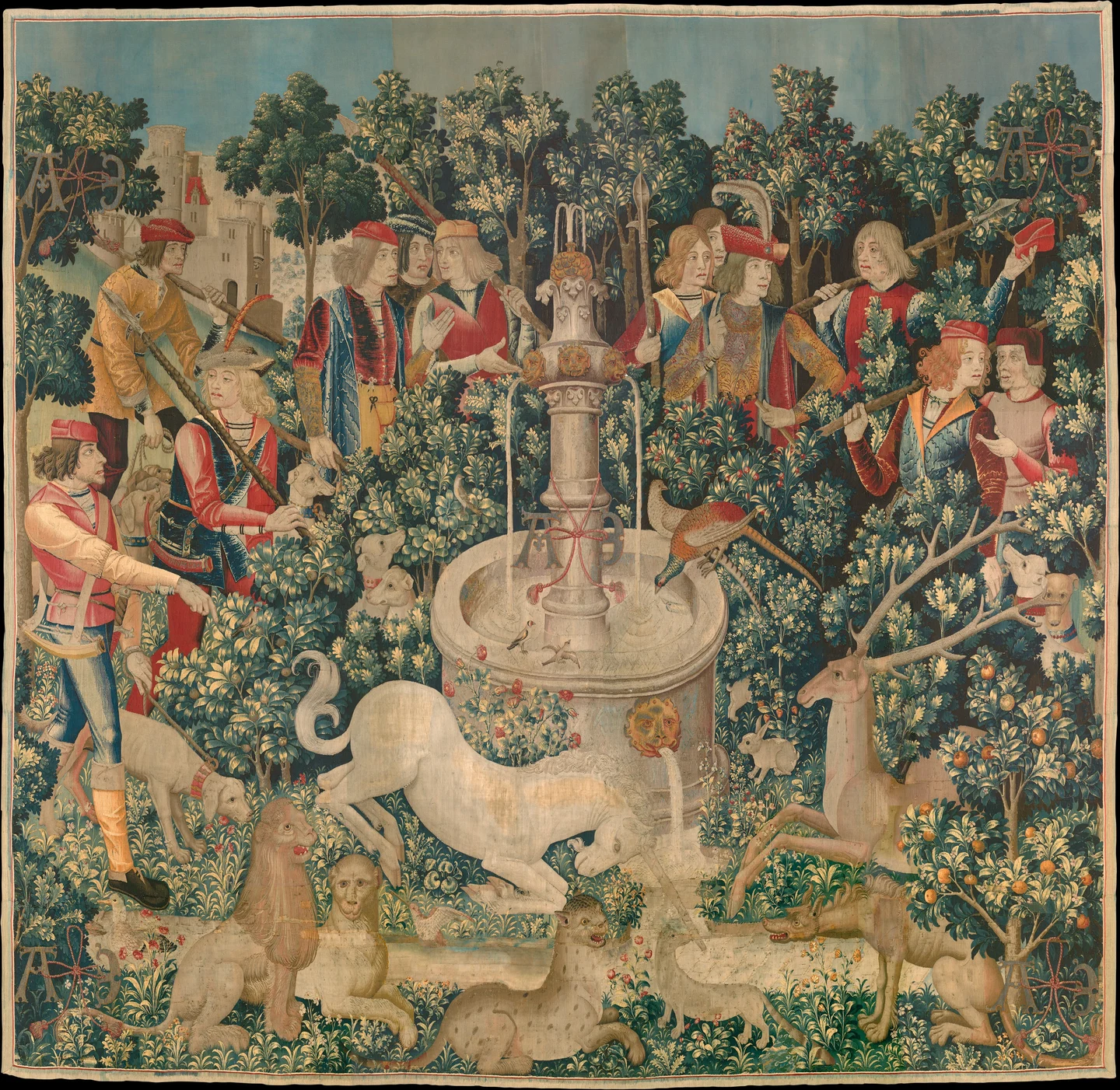
Seven panels, one riddle: the Hunt of the Unicorn at The Met Cloisters
Seven tapestries woven c. 1495–1505, looted in the French Revolution, purchased by Rockefeller for $1 million, and still hiding the identity of their patron behind a two-letter monogram.
There is a room on the upper floor of The Cloisters — the Metropolitan Museum of Art's medieval branch in Fort Tryon Park, at the northern tip of Manhattan — that you reach through a carved sixteenth-century doorway decorated with a single unicorn. The room is Gallery 17, and what hangs inside it stops most visitors cold.
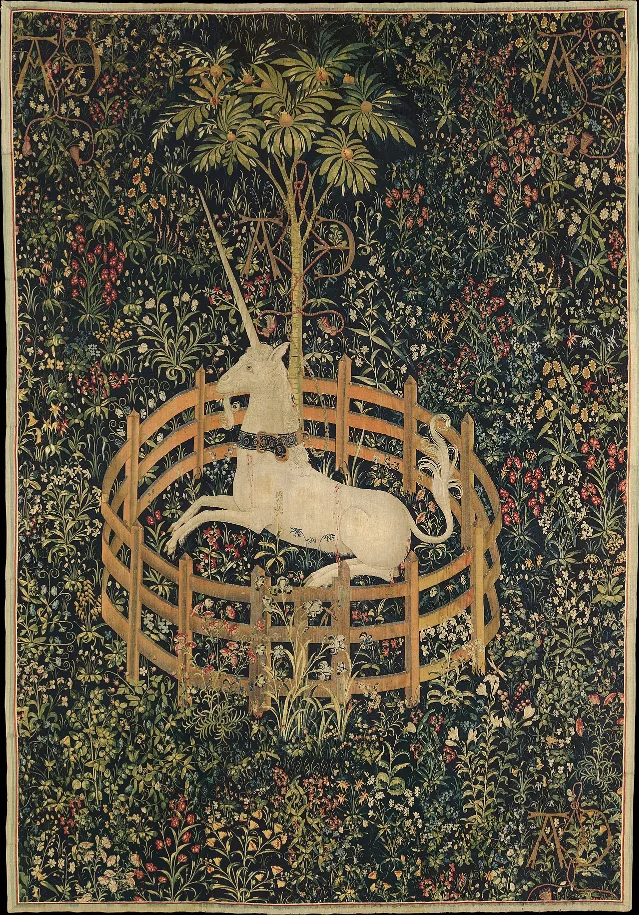
Seven tapestries cover the walls from floor to ceiling, their wool and silk and silver thread so densely woven that the surfaces seem almost to breathe. A white horse-sized creature with a single spiral horn moves through them in sequence — cornered, wounded, apparently killed, then inexplicably alive again, chained to a pomegranate tree in a small fenced garden with an expression that is either serene or resigned or possibly triumphant. In the backgrounds, more than a hundred species of plant bloom in meticulous detail on fields of deep green.
The tapestries are known collectively as The Hunt of the Unicorn, and they were woven in the Southern Netherlands around 1495 to 1505. 1 They are, by any measure, among the supreme achievements of late medieval textile art. They are also one of the most persistently unsolved puzzles in Western art history: after more than eighty years in the museum's collection, scholars still cannot say with certainty who commissioned them, who designed them, or what they were originally made to celebrate.
Seven panels in wool, silk, and gilded thread
The set consists of seven tapestries plus two surviving fragments of an eighth, all held under the accession numbers 37.80.1 through 37.80.6 (the six main panels, donated in 1937) and 38.51.1 and 38.51.2 (the fragments, donated in 1938). 2 Each panel is approximately twelve feet tall. The largest — The Unicorn Crosses a Stream — measures 145 by 168 inches (368 by 427 centimeters). 3 The smallest, The Unicorn in Captivity, is also the most famous: at 145 by 99 inches (368 by 252 centimeters), it is narrower than any other panel and may have been made as a separate, independent work. 2
The structure of each panel is wool warp, with weft threads of wool, silk, silver, and gilded metal wound around a fiber core. 4 The dyes were extracted from three plants: weld (producing yellow), madder (red), and woad (blue) — the same species that still grow in the Bonnefont Herb Garden in the Cloisters' own courtyard. By combining these in varying concentrations, the weavers produced a full chromatic range, then threaded in silver and gilt metal to catch light and add a sense of depth. The backgrounds throughout most of the series follow the millefleurs ("thousand flowers") tradition, packing the ground with plants, fruits, and flowering trees against a deep green field.
The cartoon designs — the full-scale working drawings from which the weavers worked — were almost certainly made in Paris, then sent to Brussels for execution. 5 By the late fifteenth century Brussels had become Europe's dominant tapestry-weaving center, partly because the city's Saint Luke's Guild had obtained a monopoly on producing figural cartoons in 1476, and partly because it had long served as the principal residence of the Burgundian court in the Netherlands. 5 The human figures in the Hunt — their rounded faces, their tight-fitting doublets, their pointed shoes — are closely related to Parisian woodcuts and engravings of the 1490s, and the overall design aesthetic belongs unmistakably to the French late Gothic tradition. 1
One element appears on every single panel without exception: a pair of letters, A and E, connected by a knotted cord, woven into corners, centers, dog collars, and tree branches. This monogram is the tapestries' deepest riddle.
The cipher that refuses to yield
Every panel contains the AE monogram, in some panels five times or more. 4 The letters appear too deliberately and too frequently to be coincidence. They must identify someone — a patron, a recipient, a couple — but who?
The first scholarly answer came in 1942, when James J. Rorimer, then a curator of medieval art at the Metropolitan and later the museum's director (and one of the "Monuments Men" who helped protect European art from Nazi looting during World War II), published a paper in the Metropolitan Museum of Art Bulletin titled "The Unicorn Tapestries were made for Anne of Brittany." 6 Rorimer argued that A and E were the first and last letters of Anne, and that the tapestries had been made to celebrate her 1499 marriage to King Louis XII of France. It was an elegant theory, and it became the museum's official line for thirty years.
It did not survive scrutiny. In 1976, Margaret B. Freeman, another Met curator, published The Unicorn Tapestries, a 244-page scholarly monograph that systematically dismantled Rorimer's case. 7 Anne of Brittany's documented tapestry commissions all used a different visual vocabulary and bore her heraldic devices; nothing about these tapestries pointed to her. In 1998, Adolph S. Cavallo repeated the rejection in the most recent authoritative catalogue of the series. 8
The most plausible alternative, as Freeman argued, is that the AE monogram stands for Antoine de La Rochefoucauld and Antoinette de Amboise, a French noble couple who married in the late fifteenth century and whose family owned the tapestries continuously from the first documented reference in 1680 through to their sale in 1922. 1 But "plausible" is not "proven." No account book, no inventory from the 1490s, no letter of commission has ever been found to confirm it.
Nancy Wu, an educator at the Cloisters, observed that the cipher's very omnipresence makes it tantalizing: "The AE cipher is so prevalent — the artist couldn't be more generous in trying to tell us something about the owner." 6 Her best hope for an answer, she added, lies in archival work. As of the most recent scholarly publication on the subject, former Met director Tom Campbell noted in 2002 that "experts still do not know for whom or where [the tapestries] were made." 1 Nothing has changed that assessment since.
The story the tapestries tell — twice simultaneously
The seven panels form a hunt narrative, following the pursuit, capture, apparent death, and resurrection of a unicorn through a forest and garden setting. The Met arranges them in the following sequence: 1
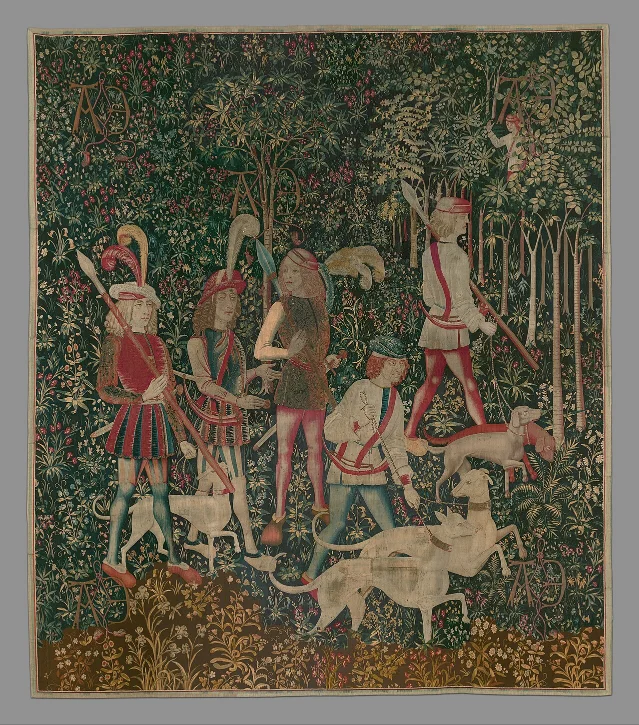
- The Hunters Enter the Woods — a party of noblemen, hunters, and hounds advances into the forest. 4
- The Unicorn Purifies Water — the unicorn kneels at a fountain, dipping its horn into the stream so that people and animals may safely drink. 9
- The Unicorn Crosses a Stream — the wounded unicorn leaps a stream as hunters close in with spears. 3
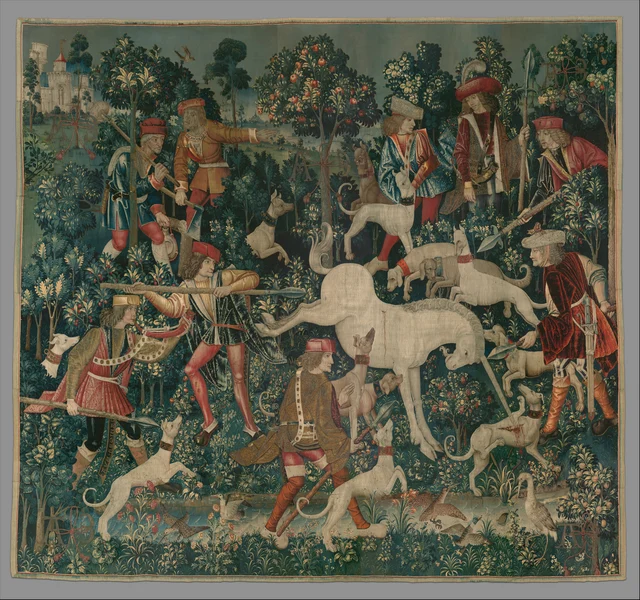
- The Unicorn Defends Himself — cornered by three hunters, the unicorn turns and attacks a greyhound. 10
- The Unicorn Surrenders to a Maiden (two fragments only) — the unicorn lowers its head into a young woman's lap in an enclosed garden. 11
- The Hunters Return to the Castle — the unicorn is killed and its body carried back on horseback to a lord and lady waiting at a castle gate. 12
- The Unicorn Rests in a Garden — the unicorn sits alive in a fenced garden, chained to a pomegranate tree. 2
This sequence carries two distinct, fully developed allegorical readings — and Freeman argued they were designed to coexist, not compete.
The Christological reading draws on a tradition going back to the Physiologus, a late antique natural history text compiled around the second to fourth century CE, which established the unicorn as a symbol of Christ. 13 A beast that could only be captured by a virgin — the tradition held — mapped naturally onto the Incarnation: Christ entering the world through the Virgin Mary. The hunt that follows reads as the Passion: pursuit, arrest, torture, death. The seventh panel — the living unicorn in the garden, its wounds healed — then becomes the Resurrection. The wound on the unicorn's right flank mirrors the lance-wound inflicted on Christ at the crucifixion. 6 The red droplets on the unicorn's coat in the seventh panel, scholars have argued, are not blood but pomegranate juice — the unicorn is alive, and the fruit dripping on it is a symbol of abundance and renewal, not death. 2
The courtly love reading layers over this without contradiction. The taming of the unicorn by a maiden was, in thirteenth-century French poetry, a standard metaphor for the lover's surrender to his lady. Thibaut of Champagne and Richard de Fournival both used the image, and Freeman traced its presence throughout the tapestries in specific botanical choices as well as compositional ones. 7 The chain in the seventh panel — a gold collar around the unicorn's neck — was in medieval love poetry the standard symbol of the loyal lover's bondage to his beloved. The pomegranate, with its hundreds of seeds, was the era's primary fertility emblem. The low fence the unicorn could easily jump, but doesn't, reads as contented captivity: the lover who could leave but chooses to stay. Freeman's conclusion was that in the late medieval imagination, "the God of Heaven" and "the God of Love" were overlapping concepts, and a commission celebrating a marriage could quite comfortably invoke both without irony. 7
The plant life throughout the series rewards this dual reading at every level of detail. More than 100 species of plant appear across the millefleurs backgrounds; 85 have been positively identified by botanists, in the first systematic study by E. J. Alexander and Carol H. Woodward published in the Journal of the New York Botanical Garden in 1941. 1 The seventh panel alone contains approximately twenty species depicted with scientific accuracy surpassing any botanical textbook of the period, including English bluebells, oxlip, bistort, cuckoopint, and Madonna lily. 14 Richard Preston, writing in The New Yorker in 2005, noted that botanists have been unable to identify a small number of plants in the series — and that these may represent species that have gone extinct since 1500. 14 Every plant in the healing-fountain scene (Panel 2) carries medicinal or antidotal associations referenced in medieval herbals: sage, marigold, orange.
A revolutionary night in a French château
The tapestries' first confirmed appearance in the historical record is 1680, when a household inventory recorded them hanging in the Paris residence of François VI de La Rochefoucauld — the moralist and memoirist, author of the Maximes. 1 In 1728, a formal estate inventory placed five of the panels in the bedroom of the family's ancestral seat, Château de Verteuil in the Charente region of western France, with two more stored near the chapel. 1 Whether the tapestries had been at Verteuil continuously since their creation — and whether the La Rochefoucaulds were their original owners — cannot be confirmed. The 177 years between the last possible date of weaving and the first inventory entry is a silence that no archive has yet filled.
1793 was the worst year the tapestries survived. During the Terror, revolutionary agents looted Château de Verteuil. Contemporary accounts recorded the tapestries being used to cover potato stores and wrap bales of hay. 1 The panel that is now represented only by fragments — The Unicorn Surrenders to a Maiden — was cut apart during this period; pieces of it were reportedly used as bed curtains. 11 The rest of the series survived but emerged badly damaged.
The family retrieved what remained sometime in the 1850s, finding the tapestries in the château's barn. They were cleaned, repaired, and rehung in the salon in 1856, where a visitor described them as "quaint fifteenth-century hangings" that nonetheless showed "incomparable freshness and elegance." 1 The two surviving fragments of the maiden panel stayed with the La Rochefoucaulds even after the rest of the tapestries were sold; Rockefeller would spend sixteen years tracking them down.
Rockefeller, Rorimer, and the opening of The Cloisters
In 1922, John D. Rockefeller Jr. purchased the full set through the Paris art dealer Edouard Larcade, who exhibited the tapestries at Anderson Galleries in New York. The seller was Comte Aimery de La Rochefoucauld. The price was approximately $1 million — roughly equivalent to $19 million in 2025. 1
For the next fifteen years, the six main panels hung in Rockefeller's private residence at 10 West 54th Street in Manhattan. The decision to give them to a museum was bound up with his larger project of creating a dedicated home for medieval art in New York — a project that had begun in 1925, when he purchased a collection of medieval architectural fragments assembled by the sculptor and dealer George Grey Barnard, including pieces of four French and Catalan cloisters. 15 Rockefeller also donated Fort Tryon Park and its hilltop site to the city, commissioning the architect Charles Collens to build a new structure incorporating the salvaged stonework.
James Rorimer — then beginning what would become a long curatorial career at the Met, and later one of the "Monuments Men" who tracked Nazi-looted art during and after World War II — played a central role in acquiring works for the new museum. Calvin Tomkins, writing in 1970, described Rockefeller's patronage of the Cloisters as "perhaps the supreme example of curatorial genius working in exquisite harmony with vast wealth." 1
In 1937, Rockefeller donated the six tapestries to the Metropolitan Museum (accession numbers 37.80.1–37.80.6). The following year he separately negotiated with the La Rochefoucauld family for the two surviving fragments of the maiden panel, which were donated in 1938 as 38.51.1 and 38.51.2. 11 On May 10, 1938, the Cloisters opened to the public. The tapestries hung in Gallery 17, where they have remained ever since.
What washing revealed
In 1998, the Cloisters undertook a renovation of Gallery 17. The tapestries were carefully rolled and transported under security to the Metropolitan's main building on Fifth Avenue, where the Textile Conservation department operated what staff called the "wet lab." There, a team led by conservator Kathrin Colburn began removing the linen backing that had been attached to the tapestries at some point in their earlier history.
What they found stopped work. The backs of the tapestries — protected from five centuries of light and air — were incomparably more vivid than the fronts. Colors that had faded to muted earth tones on the displayed surfaces blazed on the reverse in saturated crimson, cobalt, and gold. Colburn later described the process of removal: "We simply got carried away, seeing how the materials were used — how beautifully they were dyed and prepared for weaving." 14 The reverses also confirmed what the conservators had suspected: the medieval weavers were meticulous. Where cheap tapestries carry a tangle of loose threads on the back, the Unicorn tapestries' reverses are nearly smooth, the thread ends buried out of sight with the care of craftspeople who knew their work would be seen.
The panels were then washed in tubs of purified water, about six inches deep. Peter Barnet, the museum's medieval art curator, watched the process: "Intellectually, I knew the colors wouldn't bleed, but the anxiety of seeing a Unicorn tapestry underwater is something I'll never forget." 14
Museum director Philippe de Montebello ordered that both sides of each tapestry be photographed in high resolution before they were rehung. The photography team, led by studio director Barbara Bridgers, used a Leica digital camera to shoot each panel in overlapping sections roughly three feet square, with the largest single tapestry requiring 24 separate exposures each at five thousand by five thousand pixels. 14 The resulting data filled more than two hundred CDs.
Assembling the images into seamless composites proved to be an entirely different problem. Gregory and David Chudnovsky — two mathematician brothers at Brooklyn Polytechnic who were known for computing pi to more than two billion decimal places on a homemade supercomputer — were brought in to handle the stitching. What defeated commercial software was what Gregory Chudnovsky called the tapestry's fundamental nature: "The tapestry is like water. Water has no permanent shape." 14
The problem was that wool, silk, and metallic thread all expand and contract at different rates in response to changes in temperature and humidity — so the tapestry's shape shifted measurably between each exposure. The medieval weavers had also packed their threads at varying densities across the surface, creating a three-dimensional topology that no single plane could describe. Each pixel in the final composite had to be located not by matching adjacent pictures but by solving a system of equations accounting for the local deformation of the surface. The Chudnovskys spent three months of computation finishing a single panel — The Unicorn in Captivity — producing what was at the time the largest and most complex digital image ever made of a work of art. 14
The weaving itself, the Chudnovsky project made tangible, was an almost incomprehensible act of patience. One skilled medieval weaver could complete about one square inch of tapestry per hour. A team of four to six weavers working the largest panels would have needed at least a year each, working continuously, to finish the work. 14 The identity of those weavers, like the identity of the patron, is unknown.
The question that remains
Timothy Husband, longtime curator of medieval art at the Cloisters, has described a private ritual: on Mondays, when the museum is closed to visitors, he walks into Gallery 17 alone and tries to see the tapestries as if for the first time. "Sometimes I come in here and try to pretend I have never read anything about them, never heard anything about them, and I just try to look at them. But it's not easy to shed that baggage, is it?" 14
The baggage is eighty years of scholarship, most of it inconclusive. Scholars know what the tapestries are made of, roughly where and when, and through whose hands they passed from a French château to a Manhattan apartment to a museum on a hill overlooking the Hudson. They can read the botanical symbolism and trace the Christological allegory and identify the courtly love conventions with precision. What they cannot do is answer the question that the AE monogram raises every time someone looks at it: who are you?
Husband's other response to the problem, he has said, is simpler: "To hell with it, someday someone will figure them out. And then there is a solace in their beauty, and one can stare at them in pure amazement." 14
The weavers who spent a year or more on each panel, following a designer's cartoon whose author they almost certainly never met, did not know they were making something that would still be argued over five centuries later. They knew they were making something extraordinary. That much, at least, was obvious from the start.
Cover image: The Unicorn Purifies Water (Panel 2), from The Hunt of the Unicorn, c. 1495–1505. Southern Netherlands. Wool warp, wool, silk, silver, and gilt weft. The Metropolitan Museum of Art, The Cloisters Collection, Gift of John D. Rockefeller Jr., 1937, acc. 37.80.2. Image courtesy of The Metropolitan Museum of Art (Open Access).
参考ソース
- 1The Unicorn Tapestries — Wikipedia
- 2The Unicorn Rests in a Garden — Met Collection
- 3The Unicorn Crosses a Stream — Met Collection
- 4The Hunters Enter the Woods — Met Collection
- 5European Tapestry Production and Patronage — Met TOAH
- 6Why the Mystery of the Met's Unicorn Tapestries Remains Unsolved — Artsy
- 7The Unicorn Tapestries — Metropolitan Museum of Art (Freeman 1976)
- 8The Unicorn Tapestries at the Metropolitan Museum of Art — archive.org
- 9The Unicorn Purifies Water — Met Collection
- 10The Unicorn Defends Himself — Met Collection
- 11The Unicorn Surrenders to a Maiden — Met Collection
- 12The Hunters Return to the Castle — Met Collection
- 13Unicorn — Wikipedia
- 14Capturing the Unicorn — The New Yorker
- 15The Cloisters — Wikipedia
このコンテンツについて、さらに観点や背景を補足しましょう。